
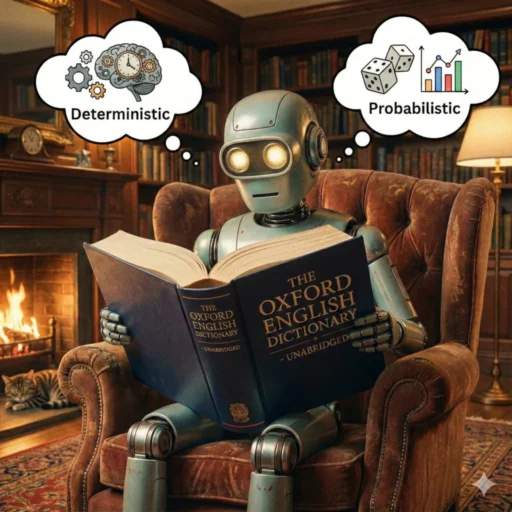
These two thirteen-letter words are not commonly used in everyday conversation, but when working with AI, the concepts behind them are crucial.
A deterministic process is one where the same input always produces the same output. There is no ambiguity. A calculator is deterministic, and so is a rule like: if an invoice is over £10,000, it must go to a manager for approval. When an if/then/else rule is involved in the decision-making process, it is considered deterministic.
A probabilistic process deals in likelihoods rather than certainties. A weather forecast does not say what will happen, only what is most likely to happen. Interpreting an email’s intent, assessing whether a transaction looks suspicious, or deciding whether a customer sounds frustrated are all probabilistic judgments. Continuing the example of a high-value invoice that has gone to a manager for approval, the manager will use their skill, judgement and prior experience to determine whether to approve it or not. There are no hard and fast rules involved, an educated opinion is required.
Each can be simple or extremely complex. Similarly, each is only as good as the rules built into it, and in the case of AI, the model and training data.
Most business processes, manual or automated, involve both kinds of work, but we rarely think of them in these terms, and that is a problem. AI muddies the waters further, giving the illusion of deterministic processing when really it is all probabilistic.
Humans: The Original Hybrid System
Think of an office with people sitting at desks with no computers, processing paperwork from an in tray and putting it in an out tray. They follow scripts, checklists, and procedures, executing deterministic steps manually. Checking for errors or missing signatures and then rubber-stamping the papers.
Where an exception occurs that is not covered by the rules, those office workers may use their judgment to decide how to handle it, or pass it on to a supervisor to decide. That is a probabilistic step.
This works, but imperfectly. Humans are capable of following rules, but we are not naturally deterministic. Fatigue, incentives, interpretation, distraction, and context all introduce variation. Sometimes that flexibility is valuable. Often, it is a source of error.
Humans have traditionally covered both deterministic and probabilistic work, which is why organisations often failed to notice the distinction until machines entered the picture.
What IT Systems Automated and What They Didn’t
Traditional IT systems automated the most obvious deterministic work: calculations, validations, routing, and enforcement of policy. Where absolute correctness and repeatability were important, machines replaced people.
But much deterministic work remains manual today. Office workers still copy data between systems, follow scripted procedures, and perform compliance steps. This is not because humans are ideal for this work, but because automation was and still is expensive, slow to change, or just too much effort.
As a result, even where IT systems have automated part of the work, replacing paper-based systems in many cases, the logical structure of the work being done by many human workers hasn’t changed a great deal, only the tools they use to do it.
Enter AI.
AI Systems Are Probabilistic by Design
AI systems work very differently from traditional software. They do not “know” things in the deterministic sense. They estimate what is most likely to be correct based on patterns in data.
Even when an AI appears confident, it is still producing a probability-weighted answer. A small change in the choice of words fed in will very likely produce different words in the response. Consistency is not guaranteed.
AI excels at the kinds of probabilistic tasks humans have always handled: interpretation, classification, summarisation, pattern recognition, and prediction.
But while humans can handle both deterministic and probabilistic tasks as standard, AI cannot reliably do that without external tools or, at least, careful supervision.
So, we have:
- IT systems that can handle deterministic logic.
- AI systems that can handle probabilistic logic.
- Humans can handle both, but with some limitations and variability.
The Mistake is Asking Probabilistic AI to Do Deterministic Work
AI systems appear reliable. They speak fluently, reason plausibly, and operate at scale. It is natural to ask them to “just handle the process end to end.”
That is the mistake. For simple use cases that are not mission-critical, the rules and guardrails built into AI systems may suffice, but errors will occur at some point when there is unexpected input. When these systems are linked to other systems, these small, occasional errors may quickly compound and escalate.
Under sufficient pressure, and beyond a certain level of complexity, there can never be enough rules to eliminate all unexpected outcomes. And adding too many rules can create conflicting constraints, causing inconsistent behaviour. These errors may be few, but they will be there. If any process requires 100% reliability, this can be a problem.
Layered Systems with Clear Accountability
Real-world systems are not neat one-way pipelines. A human worker might (probabilistically) manage another human worker who processes paperwork according to a script and sends out emails (deterministically). A report might be set to run overnight (deterministically), which is analysed by a manager (probabilistically) and discussed in a team meeting (probabilistically).
In an automated world, an AI agent may delegate work to other AI agents. Each agent may call deterministic tools to retrieve or update information, or send out emails. An agent may invoke a rules engine to deterministically reach a decision and pass that back to another agent to decide probabilistically whether to approve or deny a request.
The point is, each decision or action in a business process can be categorised as either deterministic or probabilistic, or at least be broken down into smaller parts that can be. For our own sanity, we should be using the appropriate solution for each type of task and not expecting AI to simply do it all for us.
This is not diminishing the role of AI; this is placing it where it should be. A calculator is better at doing simple maths than an AI. Even the most primitive programming language is better, faster and cheaper at if/then/else or decision tree logic than a super powerful AI.
AI can go beyond simple management roles and analyse outcomes to suggest better rules, monitor systems for errors, decide when to invoke other agents or tools, and escalate uncertainty or risk. These are probabilistic, judgment-heavy responsibilities, and they are exactly where AI adds the most value.
And of course, humans retain final authority. They approve rule changes, accept risk, and intervene when consequences are new, irreversible, or ethically sensitive. Accountability must remain with humans because legal responsibility cannot be transferred to an AI system.
A Concrete Example: Insurance Claims
Consider an insurance claim.
- A customer submits free-text descriptions, photos, and documents. AI interprets the material and extracts the necessary information. This is probabilistic.
- The AI then creates a record in the IT system. This is deterministic.
- The AI then classifies the claim, estimates fraud risk, and summarises key details. This is probabilistic.
- Based on confidence thresholds, the system decides whether the claim qualifies for fast-track handling or requires further scrutiny. Again, probabilistic.
- The claim then passes through a rules engine that applies coverage limits, deductibles, exclusions, and payment caps. This is deterministic execution.
- If risk or value thresholds are exceeded, the case is escalated. This is a deterministic decision.
- A human reviews it, approves exceptions, or decides whether the rules themselves should change. Probabilistic.
- Over time, AI analyses outcomes across thousands of claims and recommends improvements, but humans approve those changes before they affect execution. Probabilistic.
AI is not replacing the system. It is replacing individual responsibilities within the system, those that are probabilistic. The deterministic responsibilities are separated out and defined as tools that are used by either the AI or humans.
This is why it is so very important to understand the meaning of these two words. These concepts are at the core of reliable AI system design.
Conclusion: Stop asking AI to be a Machine that it is not
For most of history, humans were both the thinkers and the machinery, making judgments while also executing rules. IT systems took over some of that machinery. AI now offers an alternative method of making judgments.
What it does not offer is certainty.
The future of AI in business is not fully autonomous agents replacing entire systems. It is layered systems, humans and tools working together, with clear separation between reasoning, execution, and accountability.
Organisations that understand this will scale AI safely and sustainably. Those who don’t will eventually learn the lesson after something important goes wrong.